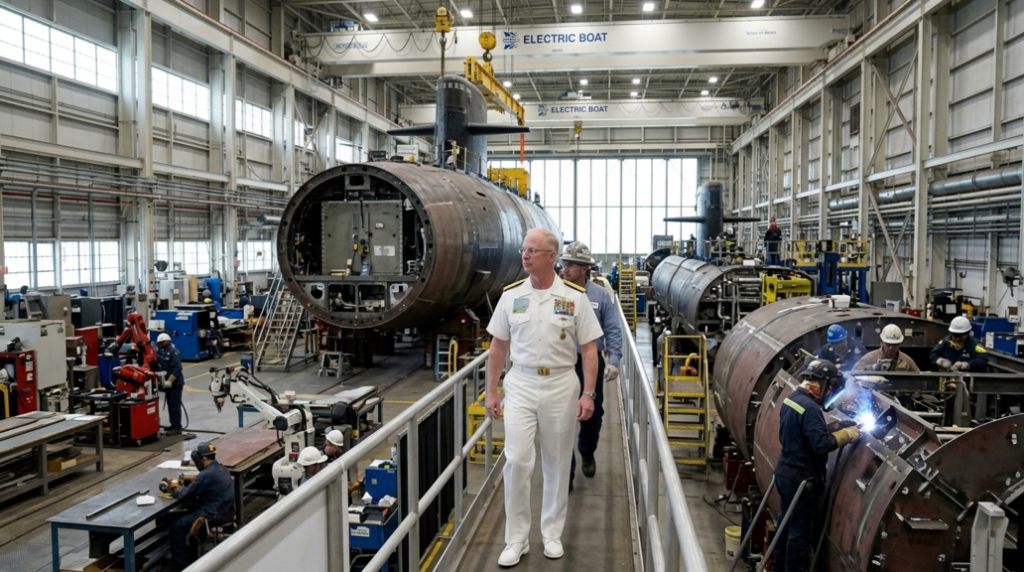
The U.S. Navy is poised to increase its production capacity for Virginia-class attack submarines, with expectations to deliver two submarines per year by the early 2030s. Chief of Naval Operations Admiral Daryl Caudle announced this projection during a recent briefing with defense appropriators, highlighting the ongoing investments in both the submarine industrial base and workforce capabilities.
Currently, shipbuilders are operating at a rate of approximately 1.1 submarines per year. However, with enhancements in manufacturing processes and workforce training, the Navy anticipates that builders General Dynamics Electric Boat and HII’s Newport News Shipbuilding will achieve the two-per-year target by 2032. This development reflects a significant step forward in U.S. naval capabilities and readiness.
The Virginia-class submarines are integral to the Navy’s fleet, designed for a variety of missions including anti-submarine warfare and intelligence gathering. The increase in production is expected to bolster the U.S. Navy’s strategic posture, particularly in the context of evolving global threats and maritime security challenges.
Admiral Caudle indicated that the Navy’s plans are based on a comprehensive evaluation of current resources and future needs. The investments made in the submarine industrial base, including advanced technologies and expanded facilities, have laid the groundwork for this increased output. Such enhancements not only aim to meet military requirements but also to support the broader U.S. defense industrial base.
The anticipated ramp-up in submarine construction could have positive implications for American workers in the shipbuilding sector. As production rates increase, there may be a corresponding demand for skilled labor in areas such as engineering, manufacturing, and maintenance. This could lead to job creation and training opportunities in communities surrounding shipbuilding facilities.
Moreover, the focus on expanding the submarine industrial base underscores the importance of maintaining a robust domestic manufacturing capacity. By investing in local shipbuilding capabilities, the U.S. aims to enhance its self-reliance in defense production, which can be crucial during times of geopolitical uncertainty.
As the Navy works towards achieving this two-per-year build rate, it reflects a broader strategy to modernize its fleet and ensure that American naval forces remain competitive. The ability to produce more submarines efficiently could also strengthen supply chains associated with defense manufacturing, fostering a healthier industrial ecosystem.
In conclusion, the commitment to increasing the production of Virginia-class submarines illustrates a proactive approach to national defense and industrial capacity. This initiative not only aims to enhance military readiness but also highlights the importance of workforce development and local economic growth within the shipbuilding industry.